
Dabba trades also allow investors to avoid SEBI registration requirements or the margin requirements set by exchanges.

Arun Jaitley had promised to provide more than the budgeted amount.

'The Fed rate will peak in the range of 5.1-5.3 per cent during the second quarter of CY23 and will most likely stay there for a while before rate cuts start in CY24.'

The 30-share Sensex ended down 35 points at 26,349 and the 50-share Nifty ended down 20 points at 7,864.

The market capitalisation of BSE-listed companies jumped to a record high of Rs 2,40,04,664.28 crore on Tuesday, driven by a rally in stocks that also saw the benchmark Sensex touching its lifetime peak of 53,887.98 points. Rallying for the second consecutive day on Tuesday, the 30-share BSE index closed at a fresh closing peak of 53,823.36 points, a jump of 872.73 points or 1.65 per cent. During the day, it zoomed 937.35 points to 53,887.98 points.

Bad debt rules are steps in right direction.

Rate sensitive sectors rallied the most led by banks while metals surged on rebound in commodity prices

Sensex catapults 1,241 points and Nifty vaults 382 points in two sessions in a row.

Indian society may be more advanced than we think it is, notes Ajit Balakrishnan.

Since the beginning of 2020, i-bankers have collected nearly Rs 1,800 crore by way of IPO fees. Interestingly, the India fees this year form just 1 per cent of the global fee pool of $13.7 billion from IPOs.

India Inc on Thursday pitched for continuation of reforms while ensuring tax and policy stability in the forthcoming Budget to prop up the economy hit hard by the COVID-19 pandemic. In the virtual pre-Budget consultation held with Finance Minister Nirmala Sitharaman, industry chambers said that government measures will help firmly entrench the nascent signs of recovery being currently seen in private investment. Capital expenditure by the government through enhanced infrastructure spending should in the meantime continue to support growth, CII president TV Narendran said.
The move, amid a rise in slippages from restructured assets, is aimed at resolving stress in the banking system.

Mixed global cues and decline in crude oil prices further dent the sentiments.
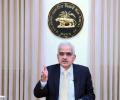
The challenge for the RBI in 2024 is likely to be less about containing elevated inflation and more about curbing excessive financial market exuberance and a 'problem of plenty', notes Sajjid Chinoy, Chief India Economist JP Morgan.

Market participants are now awaiting Thursday's meeting of the European Central Bank

Among sectoral indices, telecom led the chart, spurting 3.08 per cent, followed by oil and gas.

Business is down to such an extent that last year these firms could not even meet RBI's capital norm of Rs 50 million for partnerships and Rs 100 million for public and private firms in this line of business.

The broader markets are, however, outperforming the larger peer.

ITC was the biggest gainer in the Sensex pack, rising nearly 3 per cent, followed by Kotak Mahindra Bank, ICICI Bank, Maruti, Bharti Airtel, State Bank of India, Sun Pharmaceutical Industries, Axis Bank, Reliance Industries, Hindustan Unilever and JSW Steel. On the other hand, Infosys, UltraTech Cement, HCL Technologies, Bajaj Finserv, Larsen & Toubro, Titan, Tata Consultancy Services and Wipro were the laggards.

The RBI rejection is a second blow to BoB - the lead bank of both companies -- after a Delhi high court order on August 18 stayed a move by BoB and the entire consortium of lenders to classify these accounts as fraud, restraining them from taking any other coercive action till the next hearing.

'Inter-ministerial coordination, information on the proposed PSUs, and due diligence are taking longer than expected to conclude the process.'

Experts caution against tough times in Indian equity markets in 2015.

2013 foreign currency non-resident deposits to mature in Sep-Nov

SBI was the top gainer in the Sensex pack, jumping around 3 per cent, followed by Kotak Bank, Axis Bank, Bajaj Auto, Tech Mahindra, UltraTech Cement and PowerGrid. NSE Nifty rose 36.40 points to 15,337.85.

The Union government's finances witnessed significant improvement in August after a stressful first four months of the current fiscal year. India's gross tax revenue, comprising both direct and indirect taxes, for the first five months of 2023-24 surged 16.5 per cent year-on-year (Y-o-Y) to Rs 11.8 trillion. During the April-July period, gross tax revenue increased by a mere 2.8 per cent compared to the Budget Estimate of 12.1 per cent growth for FY24.

Ashok Leyland, ITD Cementation India have more than doubled.

Short-covering and the propping up of net asset values have potential to boost frontline as well as second-rung names next week

Analysts and economists have hailed the fiscal projections in the interim Budget, saying the lower fiscal deficit forecast shows that the government, even in an election year, is serious about fiscal consolidation and that the numbers look achievable. According to Devendra Kumar Pant, the chief economist at India Ratings, the two broad themes of the interim Budget are fiscal consolidation and stepping up focus on agriculture/rural to course correct, to some extent, the differential benefits of the ongoing economic growth that's tilted in favour of upper-income bracket/urban households. The projected fiscal deficit numbers for FY24 and FY25 suggest that the government is serious about achieving the fiscal consolidation path of 4.5 per cent fiscal deficit by FY26, and given the nominal GDP growth assumption and revenue buoyancy, the target appears plausible, Pant said in a note.

I hope those who underestimate Rajeev Chandrasekhar will be proved wrong in this fight for Thiruvananthapuram's future, notes Rajeev Srinivasan.


Sensex firm on favourable GDP numbers for FY16.

Financial shares were the top losers.

The agency said that over the next two years new NPL formation rates would witness a gradual decline.

'SBI is already too big. Too big to fail.' 'It already is a moral hazard. What will it do with 20,000 branches that it cannot do with 14,000, especially in these days of online and mobile banking?'

There is money to buy the central public sector enterprises, but buyers will need a firm assurance that the disvestment programme will keep environment issues front and centre of their corporate plans.

Foreign currency loans raised by Indian companies nosedived to $210 million in the September quarter (Q2), 93.3 per cent less than the year-ago period when five firms raised $3.1 billion. The Q2 amount is the lowest since December 2003 quarter when India Inc raised $191 million. Companies cited volatility in the currency markets, sharp rise in interest rates in the United States, and fund availability in India as the main reasons behind the sharp fall.

This period of strong growth not only offers opportunities but also calls for strategic considerations to ensure sustainable development and equitable prosperity in the years to come, suggests Sujan Hajra.

In advanced economies where the financial system is more matured, the form of shadow banking is more of risk transformation through securitisation.

Food delivery major Swiggy has received approval from its shareholders for a $1.25 billion initial public offering (IPO), according to filings made with the Registrar of Companies sourced by Tofler. The Bengaluru-based firm plans to raise as much as Rs 3,750 crore (around $450 million) via a fresh issue and up to Rs 6,664 crore (around $800 million) through an offer-for-sale (OFS) component, the filings stated.

This is a good opportunity for long-term investors to pick quality small and midcap stocks at reasonable valuations.
